Thursday, 19 August 2010

Plug it in and crank it up . . . . .

I thought that I would come back to amplification today.

I came across these pics whilst trying to organise others to be

included in the blog - I still have a lot of images to take and
prepare, so I may wander off the path now and then.

As well as having a good instrument to play, it is equally important

to have good leads/wireless, good amp and speakers that are up to
the job required of them.

Classic Rock is the order of the day, so I need something that will

pump out a good solid sound.


I have an Ashdown 300, 4 x 10 combo, which I put on top

of a 2 x 10 deep cab.
This, for me gives a good all round sound, that suits most
small and medium venues.
This pic was taken late at night, after the gig, so looks a bit
messy on stage - also there is an Ibanez Artist, which I'll
come back to later and lurking in the corner is one of my
"Rickenfakers", as they are often referred to - again, I'll
do that another time.


The "Big Rig" is a Yamaha BT500, great amp - loads of tonal

variety and five memories, which sits on top of a Hartke 8 x 10.
This is . . . . . erm. . . . LOUD!!!


Weapons of choice for that evening were the Canadian Odyssey
and a Greco GOB 750 - the Odyssey is covered in a previous post
and I'll come back to the Greco another time.

I also have an Ashdown 1 x 15, that I put on the top of the 2 x 10,
both stood on end and put the Yam on the top - great for tight
spaces and still puts out quite a punch.

One thing is for sure, each amp/cab combination, whatever you choose,
will give a different sound to a particular guitar or bass, so most of us
spend a lot of time and money trying to "Get that sound"
It's a bit like the "Lost Chord". . . . . . do you ever find it???

Talking about lost cords . . . . it's also quite surprising the effect of a good
lead or bad lead can have on the sound - some months ago I was having
a sort out and found that one of the leads I had been using was sucking
up the signal, quite noticeably, so that was consigned to the bin!!
Oh, and whilst I'm on the subject, good speaker leads are equally as
important.
It's all a bit like cooking - get the right recipe and all will turn out well.

Back next time with something different.

Cheers. :)

contactflateric@gmail.com


Friday, 13 August 2010

Gibson RD Artist Bass. . . . . . .

Something a little different from Gibson.

I always wanted one of these, preferably a Sunburst/Rosewood but I
ended up with something completely opposite, Natural/Maple! Oh well.

In my opinion, this is an instrument that every bass player should have
a go on, whether they like it or not, it would certainly be an experience.

This one, I believe, came from a "Sleaze Rock" band, called "Dizzy Bitch"


I bought this one from a guy who was using it in an Orchestra Pit, doing
West End shows, along with a huge 19th century Double Bass, with a
fourth string extension, like the Kubicki.
Very entertaining, watching him play some pieces on the upright,
surprisingly loud and a lovely tone.
Anyway, it turned out that in the seated position, this monster RD was
prone to bashing into the other musicians and therefore, had to go.
These are very powerful and the first time I plugged it into my Ashdown
rig, I had forgotten my usual precaution of turning down the gain. OUCH!
These certainly cut through, what a bite!
In a review I read, someone described it as "like a Musicman on steroids"
Alternatively, twiddle with the controls and almost everything can be
dialled in - chain-saw treble to treacle like wump!
The difference between the Standard and the Artist were cosmetic, the
pick-ups and the Moog circuit.
We had a Moog Mono-Synth, in the shop - complicated, or what???
Here's the man, himself

The variations are many, perhaps best explained here.
http://www.flyguitars.com/gibson/bass/RDartist.php
My RD is on Strap-locks and is quite comfortable to play - it will never
hang like a Jazz or an SB but for this type of design, it's not bad.

There is some interesting reading in some of the owners reviews.
http://reviews.harmony-central.com/reviews/Electric+Bass/product/Gibson/RD+Artist+Bass/10/2

There was also a "Copy" "Tribute", call it what you like, made by Jolana,
called the Disco!
http://meatexz.com/cheesyguitars/disco.html

Here comes another "Ox" connection. . . John was sort of involved in
the RD, with Gibson and Norlin but from what I understand, he never got
on with it. I think the only shots with him and the RD were promo shots.


Great Bass - love mine to bits.

And finally. . . . . Welcome Toby.
http://www.rock-til-you-drop.com/

Great to see you, my first follower - I hope there is always something
interesting enough for you to keep popping back - I still have a long
way to go!!

Cheers. :)


If you have landed on this page and you want to go to the 
latest post, go here:
Latest post. 

Wednesday, 11 August 2010

On the Rails. . . . . . .

Westone Rail Bass.

I have two of these fascinating basses, looked for ages to find one
and then another
one turned up, so I thought I would grab a spare.
Medium scale, so you can whizz up and down the board with ease,
if you are used to playing a 34" scale bass.

The neck and the two body components are made from Maple and
give it a good solid feel.
The sliding pick-up really does show how important pick-up positioning
is, and without any electronic trickery, a lot of different tones can be
eased out of this bass, simply by moving the pick-up.
Anything from sort of a Jaco bark to a Reggae dub and loads in between.

The centre component hold the pick-up, volume control and output socket.

Clever, eh??


I'm sure there are others out there that do the same thing - the Gibson
Grabber being one of them.
I also have a Quantum Bass, which is part of the family - I will come back
later with that one.
There is a great site dedicated to Westone instruments.
I also came across this a few months ago - some interesting reading from
a man who was very much involved with Westone.http://forum.westoneguitars.net/general-f1/westone-us-design-development-history-t971.htm

A fun thing that is a very serious instrument.

Back with some more another day.

Cheers. :)

If you have landed on this page and you want to go to the 
latest post, go here:
Latest post. 

Sunday, 8 August 2010

Hello World, Gig last night & Peavey T-60. . .

Hello World.

I finally got round to putting one of those visitor monitor widget
things on my Blog!
Up to now, I had no idea if anyone was reading this, so this morning,
after a very late night, I was really pleased to see some visitors.
So, to all of you out there, Hi. :)

Did a cracking gig last night - T-40 time, took one of my Sunbursts
and "Old Red". Ashdown 300, 4 x 10 plus a 2 x 10 underneath and
my Boss EQ20 pedal.
Went on at 9.30, venue said finish around 11.30, audience loving it,
kept getting the "thumbs up" from behind the bar, finished at 12.00!!
Great night!

As well as collecting, playing the instruments is important to me - little
point hiding something in the case.
As I am now well settled playing bass, I think at some point, quite a few
of the guitars will find new homes, as these do sit in the cases, coming
out now and again for a quick play and then back in the dark again.

Today I am going to show you one of the T-60's that will be staying.


This, for some reason, is just right.
I have other T-60's that are almost as good and one that is equal but
I can speak from experience, two guitars or basses, same make, year,
colour, neck, strings - one will sound slightly different to the other.
This one is a cracker.


Beautiful colour - I have others in this colour, which I will share
another time.

Anyway, off to unload the gear, so must go - hope to see you again
soon, when I will perhaps put something different up.

Anyone want to drop me a line:

contactflateric@googlemail.com

Cheers. :)


Friday, 6 August 2010

Aria Twins and a Pair of Blazers. . . . . .

Just to keep the ball rolling, I thought I'd finish off the week with these.


These Ibanez Blazers are the early ones, with a glorious pick-up,
also used by Greco.
There is nothing fancy about these basses but they deliver a real
powerful punch, over all the strings
Light, simple, a joy to play and in my opinion would be an asset to
any player who wanted the bass equivalent of a Model T.
Bright enough to cut through, back the tone off to get a BIG DEEP THUD!
Just great. The natural one was first and then the dark one, which I have
only just recently given a good going over, as it was in a bit of a state
when I first got it. The eagle eyed will notice that the intonation is a bit off
the mark, this was before I set it up.

As I have probably mentioned before, I have all sorts of gear to match
against each
other in real time.
If you pick up a great bass, or guitar, you very rarely get the opportunity
to put it up against your current favourite.
I often row up tests, same amp, volume, EQ and plug them in to see
the difference, one after the other.
I do the same when choosing what to gig next, to make any adjustments
and note them, ready for live work.


I bought my first Aria Pro II Laser heritage, the one on the right (different strings)
and on back to back tests I was very impressed, just something about it.
Did a bit of searching on t'internet and found there were a lot of good things
said about them.
Here's something typical:

"This bass is a hoot to play. Sounds and feels like a million bucks and pretty
light too.And of course, nothing beats Matsumoku's craftsmanship".

"If you see one for sale why not pick it up and have a play,
I think you'll be pleasantly surprised".

So, when another came up, I snapped it up - again, just like the Blazers, simple
straightforward but delivers what most people would want from a bass.

Used one on my last outing, just the job!

Gig tomorrow, already chosen my weapons of choice for this one -
A brace of T-40's!!

Cheers. :)

Tuesday, 3 August 2010

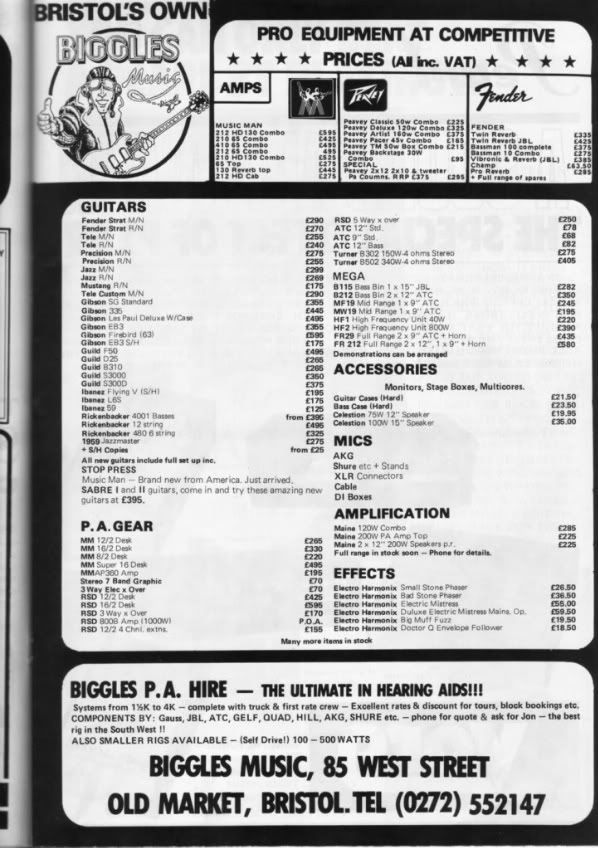
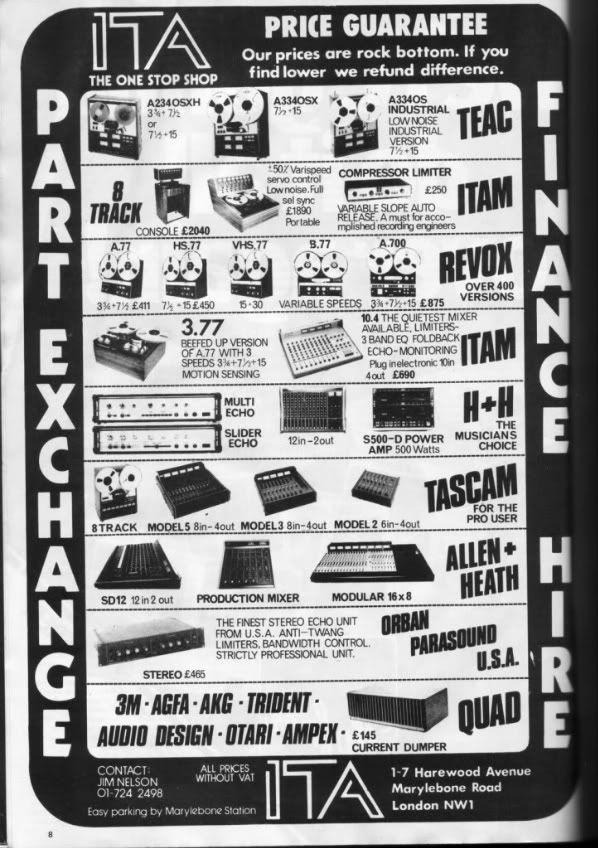
How things have changed . . . . . .

Since I have started to move this project along, I have come across all
sorts of things, including a lot of music related magazines, some of
which are over 35 years old.
These are a very interesting read and give an insight into how things
were in the 70's and beyond.
One thing is for sure, things in real terms are SO much cheaper now
than they were back then, no wonder there were a lot more second hand
shops, as that was all that most people could afford.


Just look how expensive the recording gear is!!!! OUCH!!


I have also dug out some old guitars and basses that haven't seen the
light of day for some time.
These were acquired for family and friends to learn on, as they were good
solid instruments which were there to be used, as a boutique instrument
was perhaps not the best thing to learn on, just in case it got a nasty knock.
Some I got in a swap/trade and perhaps needed a bit of TLC but never
seemed to get round to it.
I think that I may devote some time to these and move them on, as it is
now unlikely that I will use them again.

These days, even the starter guitars are quite playable, so much better
than what our heroes would have started on.
I was at The London Guitar show, a couple of years ago and a friend
brought his nephew along, to choose something acceptable.
For less than £120, he had a sort of Fender clone, soft bag, strap, lead
and from memory, even a tuner! No pitch pipes these days!

Talking of which, it still amazes me how many people struggle to tune
a guitar or bass and are completely lost without an electronic tuner.
I am still very grateful to the person who taught me tuning by harmonics,
using one string as a reference.

I am still very busy on the trail of Peter Cook, although I think I think Sherlock
Holmes would probably thinking of taking on a different case at the moment,
as I am getting some minor responses but nothing I can get my teeth into.

Any info from anyone out there, would be great - or you could just drop me a
line and say Hi - tell me what you've got. :)

contactflateric@gmail.com


Cheers. :)

Wednesday, 28 July 2010

Peter Cook. Custom Builder, where are you now?......


I was going to start on some of my Aria and Ibanez but have decided to
leave them for a while, the main reason being that I'm not sure where to
start and the fact that although they are great basses, almost all of them
gigged or rehearsed with on many occasions, I would like to make sure
that I've got the models and facts straight!!

So, I've decided to go completely the other way and feature something
from someone who I have admired for as many years as I can remember.
Peter Cook was a guitar builder for many stars, the most famous of which
is perhaps John Entwistle, The Ox, need I say more?
He was also involved in Ned Callen guitars but his Custom work is what
made him famous.


I was very lucky to acquire the Firebird Twin, which I believe is the only one
like it - Del Bromham, of Stray, had one but his was 6 over 12, mine is a
12 over 6 - I will come to that one later.
The other Peter Cook I have, is an Axis Bass, which I can honestly say
is like no other bass. This one has been very well looked after.


The controls look simple but take a lot of getting used to, in fact, I had
to call on the services of a fellow owner, who kindly explained everything
to me - all became a lot clearer!
I would be very difficult for me to explain, other than to offer what was
given to me by a fellow owner, listed below.


Eric!!!!
I've found the book and it mentions the controls!

Here you go:

1. volume knob (near back p/up)

2. cut/boost knob offering 15dB cut/boost

3. Frequency knob which works in turn with cut/boost knob (essentially,
you've got a parametric system - freq range of 80Hz to 20KHz).

4. pickup selector switch

5. pickup phase mini toggle switch

6. Active/Passive mode mini toggle switch - I assume this is a 3 way job as
it says that you get `passive with top cut, full normal passive and active on'.

Here's the actual text from the book;

The three rotary controls govern volume (aided by a pickup selector switch)
but the further two tone pots are not in use when the bass is set passive.
When active, the final two pots offer cut/boost of +/- 15dB and the frequency
selected on, what is in effect, a parametric eq system.
The switches offer pickup selection, pickup phase and active/passive mode
control; which means passive with top cut, full normal passive
and active on. Overall, the frequency range covered is 80Hz to 20KHz.
Sound wise, the Axis is possibly the most versatile active bass produced in
the UK.
A staggering variety of tones is obtainable; a far cry from from some of the
less than phenomenally ranging active basses of recent years.
If you can memorise these functions and avoid setting unusable tones,
then the overall potential is incredible.

Hope this is of use mate!

Cheers!
I have to say, when I gig this bass it gives me an odd feeling - not bad,
more "I'm playing a Peter Cook Bass, how lucky am I ?".
I can summon it up by saying that it sharpens up my playing, perhaps
I concentrate more, what's the point of having something as special as
that and fluffing everything up? :)

I am currently trying to track down owners of Peter Cook Guitars, in order
to build up a deputation to persuade him to perhaps help document his
work, over the many years he was involved in custom building.

So far I have a handful - so if there are any more of you out there, get in
touch with me - I will put a link in to a separate e.mail address, the next
time I am here.

So, I'll leave you with the pic below.

Cheers. :)

Edit: Please contact me on this address:

contactflateric@gmail.com


Friday, 16 July 2010

Some of my amp experience. . . .

I thought I would drift off course a little, as I have just bought a
new extension cab for my bass rig.
This adds to a whole lot of other gear I have and made me think of
how it all started, a long time ago.
Back in the day, there were a lot of Treble n Bass type amps and
when you didn't have a lot of the folding stuff, you took what you
could get your hands on.
Most took a little coaxing to fire up - storing them in damp
conditions didn't help.
My first guitar amps were a series of "lends" of various makes, fed
into anything you could find - who cares about ohms and some sort
of compatibility - anything that would work was good enough.
The first amp that I bought, as I was then playing bass, was
something that I can picture in my mind but can't remember what it was.
It was valve combo, 30 watt, I think, that had the head clipped onto the
open back cab, so you could take it off.
This had so much abuse but managed to survive, mainly because in
the very early days. . . . . we had no PA!!!
The next one I can't remember what that was either but I do recall
the cab - a 2 x 12, that I stood on it's end to make it look taller! :)
I think the power of the amp well exceeded to capacity of the speaker,
as on more than one occasion . . . . . a new speaker was required!
When that finally gave up I had a borrow of a Sound City, with I think
a 2 x 15 bass cab, which for a guitar set up may sound a bit odd
but it seemed to work.


This didn't last long, as my friend, who had found another band, asked
for it back, at a time I needed it most!
Bearing in mind, this was waaayyyyy before t'internet and anything you
bought was out of the paper, notices in Newsagents (remember them?? :)
or in desperation. . . . . a shop!
The next amp I do remember very well - bought through one of the notices
in a shop - a Simms Watt Combo. . . . . with reverb! Wow!
As hardly anyone took band pictures, let alone the gear, I have none
but I did lift this off the net.


This served me quite well for the stuff we were doing, Ace - How Long,
Climax Blues Band - Couldn't get it right, Boz Scaggs - Lido Shuffle,
not quite enough grind for a whole host of Lizzy, Stones and Bad Co.
stuff but this was helped out by my trusty distortion pedal.
It was orange, that's all I can remember and mated up with a Phaser,
give some interesting sounds.
I sold it in the early 80's for £60, I remember that much - a huge amount
in today's money.
Amps that followed were borrowed, begged but never stolen!!
Burman 501, ahh, those were the days - tiny thing but what a beast.
I'll come back to amps, another time.
Cheers. :)